I Saw a Girl with My Deceased Daughter’s Exact Birthmark in a Café – I Followed Her Home and Froze When I Saw the Woman She Called Mom
Twelve years after losing my three-year-old daughter, I had learned how to survive the grief, if not heal from it. Then one stop at a café on the way home from work cracked open everything I thought I knew about her death.
I’m 40. My ex-husband, Mark, is 43. We had a daughter, Sophie. She died when she was three.
Sophie had a tiny teardrop birthmark on the back of her neck, just below her hairline. Every night, I used to brush her hair aside, kiss that spot, and tell her, “This is my favorite place in the world.”
Twelve years ago, I had to leave town for a work conference. I didn’t want to go. Mark told me I was overthinking it.
Then a doctor got on the phone.
“It’s three days, Claire,” he said. “My mom is here. Sophie will be fine.”
On the second night, he called after midnight.
“Don’t panic,” he said. “She has a fever. We’re taking her in.”
An hour later, he called again.
“They’re admitting her. It’s an infection.”
Then a doctor got on the phone. “Claire, this is Elena. We’re doing everything we can. You should come home.”
I buried my daughter without seeing her one last time.
I got the first flight I could.
By the time I landed, Sophie was dead. That’s what Mark said. That’s what the hospital said. That’s what the paperwork said.
I never saw her body. They told me there were safety rules because of the infection.
The funeral director told me not to open the casket.
I buried my daughter without seeing her one last time.
A teenage girl was sitting near the window with a friend.
I broke after that. My marriage didn’t survive. I blamed Mark for not acting sooner. I blamed myself for leaving town. I blamed everyone.
I moved away. I went to Sophie’s grave every month.
Then three weeks ago, after another work trip, I stopped at a small café near the station.
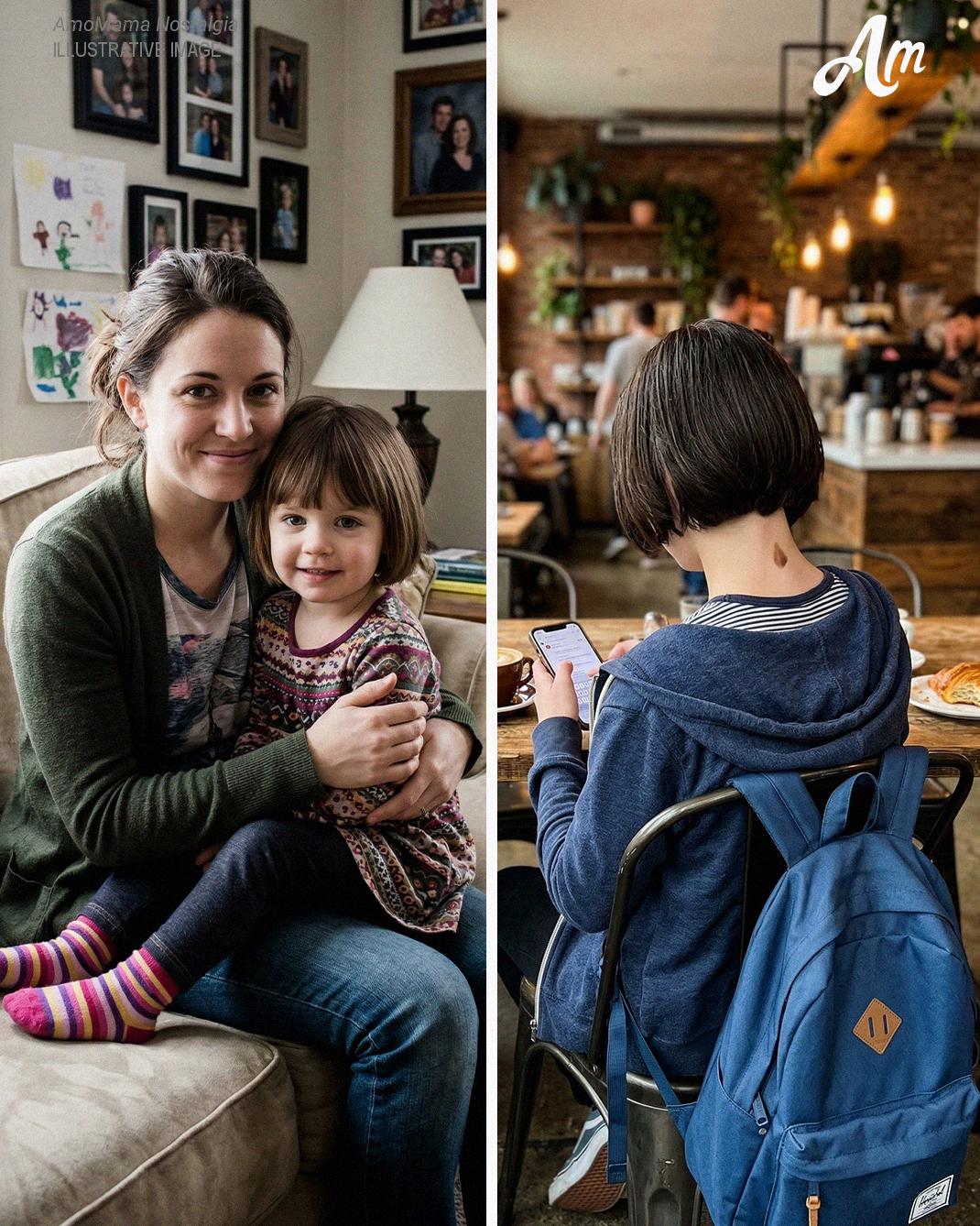
A teenage girl was sitting near the window with a friend. Dark bob haircut. School uniform. She leaned forward to show something on her phone. Her hair shifted.
The girl had no idea I was staring at her.
I saw the back of her neck.
That birthmark.
Same shape. Same place. Same dark edge.
My whole body went cold.
The girl had no idea I was staring at her.
She finished her drink, stood up, said, “Text me later,” to her friend, and walked out.
The woman looked up.
I followed her.
I know how that sounds. But I followed her anyway.
She walked through a quiet neighborhood, turned onto a side street, then another. Ten minutes later, she stopped at a small house with a white fence and a front garden.
A woman was outside watering flowers.
The girl pushed open the gate and said, “Mom, I’m home.”
I grabbed the fence to keep from falling over.
The woman looked up.
It was Elena. The same Elena who called me from the hospital the night Sophie died. The same Elena Mark later left me for.
She smiled at the girl and said, “Hey, Lily. How was school?”
Lily.
I grabbed the fence to keep from falling over.
I went back the day after that.
***
That night, I didn’t sleep. I lay in bed, replaying every second. The birthmark. Elena’s face. The way the girl called her “Mom” without hesitation.
So I went back to the café the next day.
No girl.
I went back the day after that.
Nothing.
When Lily left, she left a straw and a crumpled napkin on the table.
On the third day, she came in.
Same table. Same friend. Same short hair exposing the back of her neck every time she turned.
This time I sat close enough to hear her friend say, “Hey, Lily.”
I watched everything. The way she laughed.
When Lily left, she left a straw and a crumpled napkin on the table.
I took both.
Then I found an old obituary.
I ordered a mail-in DNA test that night.
While I waited, I finally looked up Elena. She was head of pediatrics at another hospital now. There were polished photos of her in a white coat, smiling for conferences and hospital newsletters.
Then I found an old obituary. A three-year-old girl named Emma. Same hospital. The same week Sophie supposedly died.
Cause of death: sudden infection.
I read it three times.
Emma was Elena’s daughter.
Two girls, both three. One dead. One alive.
One grieving doctor. One cheating husband. One mother out of town.
The DNA results came back two days later.
Parent-child match.
I read it three times. Then I slid down onto my kitchen floor. Sophie had never died.
For a second, she tried to pretend.
I drove straight to Elena’s hospital.
When she saw me in the hallway, the color drained from her face.
“Claire. I didn’t know you were in town.”
“Can we talk?” I asked.
She took me into a consultation room and shut the door.
For a second, she tried to pretend. “How have you been?”
“I saw her.”
I dropped the DNA report onto the table between us.
Her eyes landed on it, and I watched something inside her collapse.
“I saw her,” I said. “I saw the birthmark. I saw her call you Mom.”
Elena sank into a chair.
“Claire,” she whispered, “I’m sorry.”
“Tell me the truth.”
“Mark said he couldn’t lose her.”
Elena covered her mouth with both hands, then finally said, “My daughter died first.”
Emma had gotten sick fast. She died in the hospital. Elena had pronounced her herself.
The following day, Sophie came in with a high fever. Mark was there. Elena was there. Both of them already tangled up with each other.
“Mark said he couldn’t lose her,” Elena said. “He kept saying there had to be a way.”
I stared at her. “And?”
She looked sick. “He suggested switching them.”
“I knew it was evil.”
I didn’t even react at first.
“He said Emma was already gone. Sophie wasn’t. He said the girls were the same age. Same size. He said no one would know.”
“And you did it.”
She nodded, crying now. “I told myself no. I knew it was evil. But I had just lost Emma. I wasn’t thinking clearly. Then I looked at Sophie and thought if I let her leave that hospital, I would be burying my daughter and watching another mother take hers home.”
I felt sick. “So you let me bury Emma under Sophie’s name.”
“I thought about telling you.”
“Yes.”
“And took my daughter.”
“Yes.”
She said she altered records. Used her authority. Changed labels and paperwork.
Mark backed her up. Then he told me Sophie was dead and leaned on hospital rules so I would never see the body.
“I thought about telling you,” Elena said. “For years.”
“I was destroyed.”
“You didn’t.”
“No.”
I leaned across the table. “You’re going to tell her. With me there. Or I go to the police.”
“She’ll be destroyed,” Elena whispered.
“I was destroyed.”
We agreed to do it at her house on Saturday.
On the couch sat Lily.
***
Saturday afternoon, I sat in my car outside Elena’s house with both hands locked on the steering wheel.
Elena opened the door. “She’s in the living room.”
Mark was already there when I walked in.
He stood up so fast he nearly knocked over a chair. “Claire—”
“Don’t.”
On the couch sat Lily. She looked from one adult to the other.
I handed her an old photo of Sophie at three and the DNA report.
“What’s going on?” she asked.
Elena sat down across from her and said, “There’s something we should have told you a long time ago.”
Lily looked at Mark. “Why is she here?”
I handed her an old photo of Sophie at three and the DNA report.
She looked at the photo first. Then the paper. Then at me.
Lily just stared at her.
“What is this?” she asked.
“That little girl is my daughter,” I said. “Or I thought she was. I was told she died when she was three.”
Lily frowned. “Okay?”
Elena started crying. “You’re not my biological daughter. Claire is your biological mother.”
Lily just stared at her.
“No,” she said after a few seconds. “No, that’s not funny.”
Lily went white.
“It isn’t a joke,” I said.
Mark stepped forward. “Lily—”
She snapped, “Don’t call me that right now.”
Then she looked at Elena again. “Explain it.”
So Elena did. She sobbed her way through the truth. Emma’s death. Sophie’s illness. The plan. The switched records. The lie.
No one had anything to say to that.
Lily went white. “You kidnapped me?”
Mark said, “We were desperate.”
She turned on him so fast it shut him up.
“You decided my life for me,” she said. “You decided her life, too.” She pointed at me. “You let her think I was dead.”
No one had anything to say to that.
So I told her the truth.
Elena reached for her. Lily moved away.
“I love you,” Elena said.
“You stole me,” Lily said back.
So I told her the truth. “I didn’t leave you. I didn’t give you away. I didn’t know. I buried a child with your name on the casket and spent 12 years thinking I failed you.”
Lily looked at her with a face I don’t think I’ll ever forget.
Her eyes filled with tears.
Mark tried again. “I always stayed close. I tried to be in your life—”
“You’re disgusting,” Lily said.
Then she grabbed her phone.
Elena said, “Please don’t do this right now.”
Lily looked at her with a face I don’t think I’ll ever forget.
Now there’s an active investigation.
“You already did it,” she said.
She called the police.
Everything after that was noise. Officers. Statements. Questions. Copies of documents. Mark sweating. Elena sitting with her head in her hands. Me trying not to shake apart while answering questions like my own name.
When one of the officers asked, “You’re the biological mother?” I said yes, and my throat almost closed.
That was three weeks ago.
The therapist asked if she wanted an answer.
***
Now there’s an active investigation. Elena is on leave. Mark has a lawyer. I have one too.
The court has given me parental recognition while they sort out custody and the criminal side of this mess. For now, Lily is still staying with Elena under supervision. She sees me several times a week.
She is angry. At Elena. At Mark.
One day in therapy, she said, “I don’t know who my mother is.”
The therapist asked if she wanted an answer.
She looked down at her hands.
Lily said, “No. I want everyone else to stop acting like they have one.”
Last week, we sat in a park after a session.
Then she asked, “What was I like when I was little?”
I laughed once because I was suddenly crying too. “Loud. Bossy. You hated naps. You wanted the same bedtime story every night.”
She looked down at her hands. “Did you really kiss the birthmark?”
“I don’t know what to call you yet.”
“Every night.”
She turned around on the bench and lifted her hair off her neck.
“Show me.”
My hands shook, but I leaned in and kissed that spot the same way I used to.
She didn’t pull away.
Then she said, “I don’t know what to call you yet.”
I’m trying to get the headstone corrected.
“You don’t have to call me anything you’re not ready for.”
She nodded.
Later that night, I went to the cemetery. I stood in front of the grave I’d been visiting for twelve years and brought flowers for the child buried there, because that child was never Sophie. She was Emma.
She deserved her own name.
I’m trying to get the headstone corrected.
I don’t know how this ends. There are hearings coming. Criminal charges may be coming too.
I stared at that message for a full minute before I answered.
But yesterday I got a text. A picture of a math worksheet.
Under it, she wrote: “It’s Lily. Or Sophie. Not sure yet. Do you know how to do this?”
I stared at that message for a full minute before I answered.
Then I called her, and we spent 20 minutes arguing about algebra.
For the first time in 12 years, I got to be her mother in the most normal way possible.
That’s all I have right now. But it’s a start.
I got to be her mother in the most normal way possible.